

Receiving a request for evidence from U.S. Citizenship & Immigration Service (USCIS) is stressful. You’ve spent months gathering documents, filling out applications, and waiting for an answer, only to find out that USCIS needs more information before it can make a decision. However, it’s important to remember that a request for evidence isn’t a denial.
It means that USCIS cannot approve your application based solely on what you’ve initially submitted. If you respond appropriately, you may be able to fix the problem and provide missing evidence.
The team at Karlin & Karlin understands how stressful this process can be, and we’re here to help. Learn more about what a request for evidence means and how to respond to one.
Table of Contents



Bring the World’s Best Talent to Your Business, We’ll Make It Happen!
Your company’s success depends on access to top global talent. At Karlin & Karlin, our Corona business immigration attorneys guide you and your employees through every step of the visa process, ensuring accuracy, efficiency, and compliance. Let us help you secure the workforce you need to grow.
What Is a Request for Evidence?
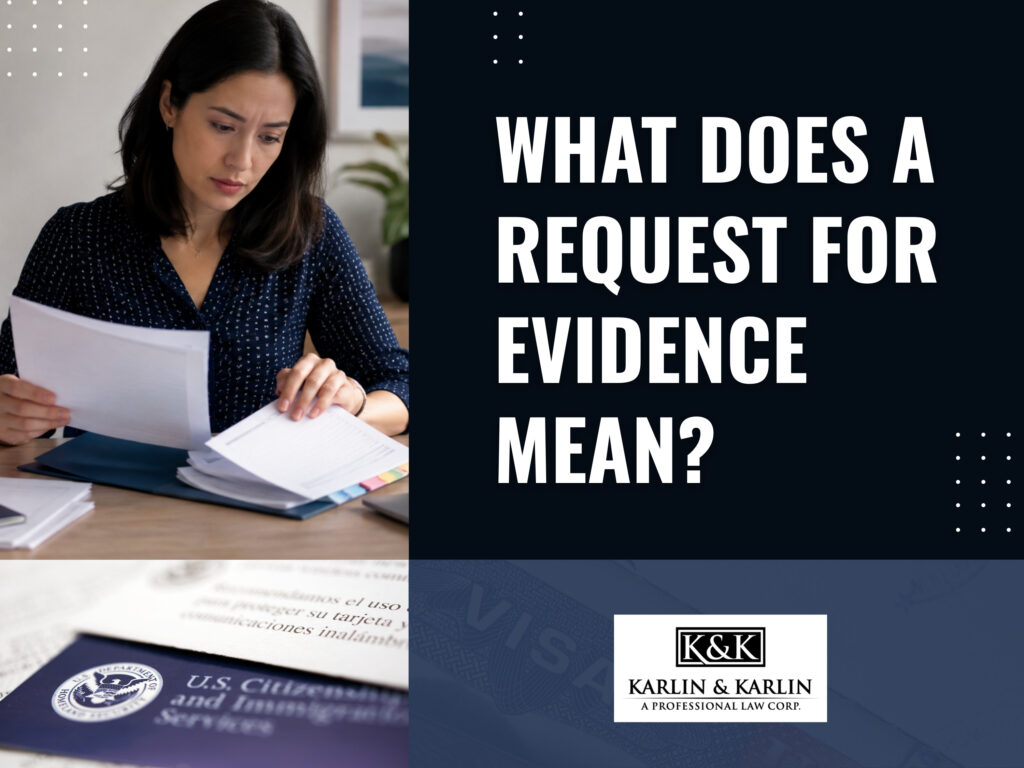
Also known as an RFE, a request for evidence is a notice from USCIS indicating that they need more documentation before they can make a decision regarding your application, petition, or immigration benefit request. Instead of denying the application because they do not have enough information, they give the applicant a chance to provide additional evidence.
RFEs are issued in many types of immigration cases, including family-based petitions, adjustment of status, employment-based petitions, naturalization, humanitarian immigration, and more. Depending on the specific details of your case, the agency may need more relationship evidence, identity documents, financial records, immigration status records, or proof that you meet a certain legal requirement.
A request for evidence is not automatically bad news, but that doesn’t mean you should take it lightly. Your response is your chance to correct the issue before the agency moves forward with a denial.
Request for Initial Evidence Meaning
A request for initial evidence usually means that a required document or piece of evidence is missing from the original filing. In this case, it’s not that USCIS needs additional clarification. It’s that the filer did not include something that was required from the very beginning. Initial evidence is usually used to determine eligibility and filing requirements. If you send in a form that requires a birth certificate and you fail to include an acceptable copy, you may receive a request for initial evidence.
Request for Initial Evidence: I-485 Reasons
Form I-485 is used to apply for lawful permanent residence from within the United States, also knowns as adjustment of status. It requires substantial supporting documentation, so requests for initial evidence can arise in these cases.
You may receive a request for initial evidence if you are missing a birth certificate, certified translation of an official document, affidavit of support, proof of lawful entry, medical exam, or proof of your eligibility. You should check the USCIS checklist of required initial evidence to avoid missing documentation.
Missing Forms, Signatures, Fees, or Required Documents
Some requests for evidence are the result of basic errors that can be promptly corrected. You may have forgotten to sign a form, used an outdated edition of a form, forgotten to include a page, or missed a supporting document. It’s important to address these issues promptly. Even if they’re easy to fix, they can still result in a denial if you do not correct them.
Experienced Legal Help, Delivered with Care and Commitment.
How to Respond to a Request for Evidence
To respond correctly to a request for evidence, you should first read it thoroughly to understand exactly what USCIS is asking for and the deadline. Depending on your immigration case, the timeframe to respond to a request for evidence may range from 30 to 84 calendar days.
You want to focus only on what they are requesting, rather than including irrelevant documents or forms that make it harder for them to complete your file. When drafting your response, ensure that it is organized, complete, and easy to review. Label exhibits and forms clearly to show that you have addressed every request.
Mistakes When Responding to A Request for Evidence
Preventable mistakes can turn an inconvenient delay into an outright denial. Applicants may miss the deadline, send unrelated documents, fail to include needed translations, ignore part of the notice, or submit unclear copies. Your response to a request for evidence or request for initial evidence should be specific, limited to what USCIS requested, and easy to follow.
How Karlin & Karlin Can Help with a Request for Evidence
At Karlin & Karlin, we’ll help you review the request for evidence to understand exactly what USCIS is asking of you. We work to identify weaknesses in your original filing and prepare a complete and concise response. It’s especially important to work with an immigration lawyer if your file involves inadmissibility, immigration violations, criminal history, or fraud concerns.
Respond to A Request for Evidence with Karlin & Karlin
If you’ve received a request for evidence and you’re unsure how to respond, our team of experienced immigration attorneys is here for you. Call us at 888-365-1555 or contact us online to schedule your free consultation now.